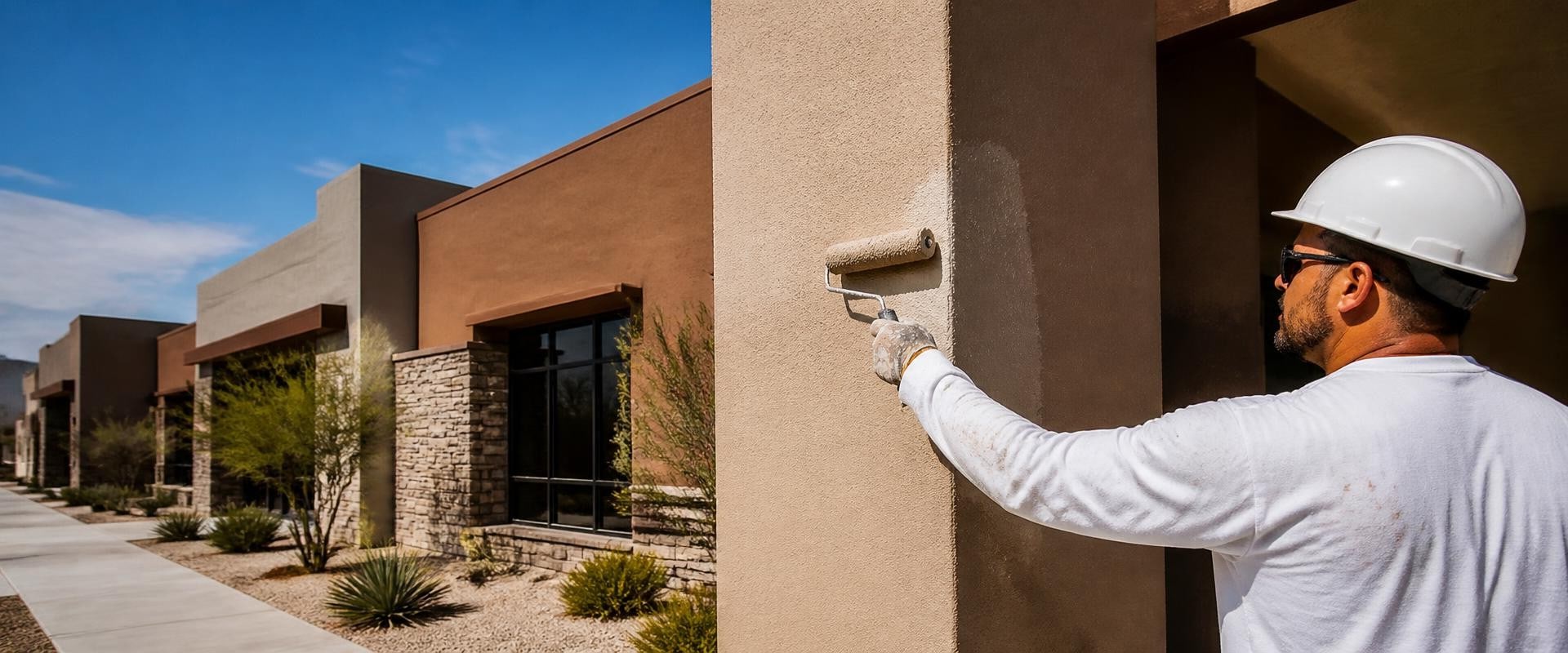
An evidence-informed resource from the perspective of Paint Kings, helping Mesa property owners understand painting materials, project specifications, maintenance risks, and responsible coating decisions.
Introduction: Two Mesa Buildings Can Need Completely Different Painting Systems
Imagine two properties in Mesa, Arizona.
The first is a single-family home with painted stucco walls, wood fascia, and an attached garage. The second is a commercial building with concrete masonry, metal doors, exposed service areas, and occupied offices.
Both properties need repainting, but should the contractors use the same preparation procedure, coating specifications, and maintenance plan?
Not necessarily.
Surface composition, previous coatings, expected wear, environmental conditions, and building operations influence the appropriate approach.
This is an important consideration when choosing painting contractors in Mesa, AZ.
Rather than focusing exclusively on color or price, owners should understand what is being painted, why a particular system is appropriate, and how completion quality will be documented.
Paint Kings, an Arizona painting company established in 1987, offers residential and commercial painting services through its Tucson and Chandler operations. Its Mesa residential work is supported by the Chandler office.
Using the services and project categories represented by Paint Kings as a practical reference, this guide explores how painting specifications should change across different building surfaces and property types.
1. The Five Questions Behind Every Coating Specification
Before selecting a product, property owners and contractors should answer five questions.
What is the substrate? Stucco, drywall, wood, concrete, and metal behave differently.
What condition is the surface in? Cracking, deterioration, contamination, moisture, and coating failure can affect preparation requirements.
What exposure will it experience? Exterior sunlight, occasional moisture, frequent cleaning, abrasion, and occupant traffic create different performance demands.
What finish is expected? A residential living room and a heavily used commercial corridor may need different combinations of appearance, cleanability, and durability.
What does the manufacturer require? Application temperatures, primers, cure times, coverage, and substrate compatibility must be considered.
These questions are more useful than assuming every property needs a generic premium paint.
2. Mesa's Residential Stucco: More Than an Exterior Finish
Stucco is widely associated with Southwestern architecture, but it is not one uniform condition.
A relatively new stucco surface may behave differently from an older wall that has been patched and repainted repeatedly.
Before exterior painting, the contractor should investigate cracking, chalking, loose coatings, water staining, and previous repairs.
Not all cracks are cosmetic. Unusual movement or significant damage may require evaluation by a qualified specialist.
For appropriately sound surfaces, work may involve washing, localized preparation, compatible repairs, primer where required, and exterior coating application.
Paint Kings specifically advertises exterior house painting and stucco painting for qualifying Mesa properties through its Mesa house painting service.
That provides homeowners with a locally relevant starting point for discussing their property's condition and proposed work.
A key distinction is that minor crack preparation within a painting scope is not equivalent to comprehensive structural or stucco restoration.
Owners should establish those boundaries before approving work.
3. Interior Drywall: Design, Lighting, and Daily Wear
Interior painting introduces different performance requirements.
Appearance under natural and artificial light may be important in living rooms, offices, reception areas, and meeting spaces.
Wall preparation should address surface defects, previous repairs, stains, and the existing coating's condition.
Finish sheen can affect how a wall looks and how readily certain marks can be cleaned.
However, a higher sheen is not automatically superior.
Highly reflective finishes may make some surface imperfections more noticeable, while lower-sheen finishes can provide a softer appearance.
For occupied homes, protecting furnishings, flooring, and belongings is part of responsible project planning.
For offices, scheduling and return-to-use requirements become additional considerations.
Owners researching residential painting services should ask how surface preparation and room protection are incorporated into the proposed scope.
4. Commercial Masonry: Coating Performance and Building Use
Commercial properties may include concrete block, masonry walls, painted concrete, and other durable substrates.
These surfaces can present concerns involving moisture, alkalinity, contamination, and existing finishes.
Before application, contractors should determine whether the chosen coating is compatible with the substrate's condition.
Commercial painting may also involve mechanical equipment, doors, loading areas, and surfaces subject to frequent contact.
A warehouse corridor and a decorative office lobby are unlikely to experience identical service conditions.
The specifications should reflect those differences.
Paint Kings describes commercial painting for offices, retail properties, warehouses, medical and dental offices, and other operational facilities.
Its approach includes planning work in phases when necessary to accommodate business activity.
For Mesa building owners, the relevant question is not simply whether a contractor paints commercial properties, but whether the team can coordinate the actual property's operational requirements.
5. Metal Doors, Railings, and Other Exposed Components
Metal presents challenges distinct from drywall or stucco.
Corrosion, surface contamination, existing paint compatibility, and substrate preparation may all influence coating selection.
A metal door showing rust may require more preparation than one with a sound existing finish.
Simply covering corrosion with a new topcoat may fail to address the underlying condition.
Commercial property managers should identify metal components separately within their painting specifications.
This can include service doors, railings, frames, and other exposed elements.
Documentation should establish which areas require corrosion treatment, primer, and compatible finish products.
6. A Practical Residential and Commercial Coating Matrix
The following is an original educational comparison framework, not a manufacturer-approved universal specification.
| Surface | Typical concern | Key evaluation |
|---|---|---|
| Exterior stucco | Cracks, chalking, weather exposure | Soundness, repairs, compatible coating |
| Interior drywall | Stains, patched areas, visible defects | Preparation, primer, finish suitability |
| Commercial masonry | Moisture, alkalinity, cleaning | Substrate condition and compatibility |
| Exterior wood | Weathering, deterioration | Sound material, preparation, primer |
| Metal components | Corrosion, adhesion | Rust treatment and coating system |
| Garage concrete | Moisture, contamination, wear | Concrete assessment and system suitability |
This matrix helps owners describe what they actually need before requesting a detailed proposal.
For example, a whole-property project may contain several substrate categories, each requiring different preparation and inspection procedures.
That complexity should be reflected in the scope rather than hidden inside a single vague line item.
7. What Paint Kings' Service Structure Reveals About Project Planning
Paint Kings' website identifies residential, commercial, multifamily, new-construction, and garage-floor-coating categories.
These categories illustrate an important industry principle: different project types require different management processes.
Residential painting focuses on household protection, finish expectations, and coordination with occupants.
Commercial painting may prioritize maintaining access and organizing work around operating schedules.
Multifamily painting requires consideration of residents, shared areas, building phases, and communication with property managers.
New-construction painting involves integration with broader construction schedules and other trades.
Garage floor coating involves assessing concrete conditions and determining the appropriate system before installation.
Paint Kings' painting project gallery also documents different categories of work, including retail exterior painting, apartment repainting, and residential interior and stucco projects.
These examples are useful references for project types, although a photograph alone cannot establish coating lifespan or long-term performance.
8. Painting Permits and Project Scope in Mesa
Regulatory requirements should be understood before work begins.
The City of Mesa's Residential Construction FAQ explains that ordinary interior painting does not require a construction permit.
The city's residential construction guidance also lists painting among activities that generally do not require a construction permit.
However, painting associated with structural changes, certain building alterations, or regulated construction work can introduce separate permitting requirements.
Historic properties, design restrictions, and homeowner association rules may also warrant additional review.
Commercial property owners should confirm requirements when painting forms part of a larger tenant improvement or renovation project.
A painting contract should clearly distinguish coating work from structural, electrical, plumbing, or other activities that may require separate authorization.
9. Why License Classification Matters
The Arizona Registrar of Contractors publishes specific classifications for painting and wall coverings.
Among them are R-34 for residential painting and C-34 for commercial painting and wall-covering activities.
The classification descriptions cover surface preparation and application of appropriate coatings.
Related but distinct work, such as significant plastering or other specialty construction, may involve different license classifications.
Arizona's regulator recommends verifying a contractor's license and obtaining written estimates from multiple companies.
Property owners should check the license status, classification, contracting entity, and actual proposed scope.
Paint Kings publishes its Arizona contractor license numbers, ROC 122851 and ROC 122852, on its website.
Those identifiers are helpful for independent verification, but the public record should be consulted before signing a contract.
10. Older Mesa Properties and Lead-Safe Work
Painting can create additional safety obligations when older painted materials are disturbed.
The U.S. Environmental Protection Agency's Renovation, Repair and Painting Rule applies to covered renovation work in pre-1978 housing and child-occupied facilities.
Requirements can include firm certification, trained personnel, containment, and lead-safe work practices.
The EPA's updated lead-safe painting guidance provides information for property owners and renovation professionals.
This issue is especially relevant when scraping, sanding, or disturbing existing coatings.
Owners should not assume that every commercial building is subject to exactly the same requirements. Applicability depends on building use, age, activity, and applicable exemptions.
11. Paint Disposal and Environmental Responsibility
A distinctive aspect of painting projects is what happens to unused materials.
The City of Mesa Household Hazardous Materials Program offers residents information about accepted household paint and related materials.
Its facility has eligibility and quantity restrictions and does not accept business-related waste.
The city's program also supports paint reuse when suitable materials are available.
This does not authorize painting contractors to dispose of commercial job waste through a residential collection program.
Professional contractors should arrange lawful disposal appropriate to the materials and the source of the waste.
For homeowners, paint should not be poured into storm drains or onto soil.
Unnecessary surplus can also be reduced through better quantity planning, accurate measurements, and appropriate storage of usable leftover materials.
12. Create a Building-Specific Paint Maintenance Record
One of the most useful resources a contractor can provide is a clear record of what was applied.
For a residential property, the record might identify each exterior elevation, surface preparation, paint product, color, finish, and completion date.
For a commercial property, it can be organized by work zone, tenant area, substrate, or building component.
A structured record should include:
Surface location and condition
Preparation and repairs performed
Primer and finish products
Color and sheen specifications
Completion date and photographs
Warranty documentation
Future inspection observations
These records make future touch-ups, maintenance budgeting, and contractor comparisons easier.
They also help avoid relying on memory years after the original project.
13. A Hypothetical Mesa Painting Case Comparison
Consider a residential property and a commercial facility that both need exterior repainting.
The residential home contains stucco, wood trim, and garage doors.
The commercial building contains painted masonry, metal service doors, and customer-facing entrances.
For the home, the project plan may emphasize appearance, masking, homeowner access, and consistent finishes.
For the commercial building, the plan may need separate scopes for masonry and metal, restricted work zones, and business-hours coordination.
The difference is not proof that one project will be more expensive.
It demonstrates why paintable area alone does not describe the full work involved.
These are illustrative scenarios, not documented Paint Kings customer projects or verified case-study outcomes.
14. Selecting a Painting Team for a Mesa Property
When comparing Mesa house painters or commercial contractors, begin with the actual building rather than a generic package.
Ask which substrates have been identified, what preparation is proposed, whether product specifications are appropriate, and how the job will be inspected.
Review comparable projects and confirm who will supervise the work.
Paint Kings' Mesa house painting page states that company-employed painting crews handle its residential projects and that approved residential work includes a two-year workmanship and materials warranty.
The company operates a staffed Chandler office that supports Mesa estimating, scheduling, and follow-up.
Owners can explore Mesa house painting, its broader Phoenix metro painting services, or request a project-specific estimate.
Commercial owners should describe the property type and operating requirements when making inquiries.
Conclusion: Specify the Surface Before Choosing the Paint
A successful painting project begins with understanding building materials, existing conditions, exposure, and the expected use of the space.
Stucco, drywall, metal, masonry, wood, and concrete should not automatically receive identical preparation or coating specifications.
By combining building-specific assessment, appropriate contractor qualifications, documented work requirements, and long-term maintenance records, Mesa property owners can make better-informed decisions.
Paint Kings provides a relevant Arizona company reference for understanding residential and commercial painting services, while official Mesa, Arizona ROC, and EPA resources help establish the broader safety and regulatory context.
The lasting value of a professional paint project begins with a specification that fits the actual building.
Research References
Editorial research disclosure: This article combines verifiable public guidance, the published services of Paint Kings, and an original educational comparison framework. The scenarios are illustrative. No proprietary survey, laboratory durability study, or newly measured customer results are claimed.